Best coffee scales for espresso and pour-over (2026 buyer's guide)
Six popular coffee scales compared on size, timer and power, so you can pick one that fits your machine and your brew.
Short answer
For espresso, pick a small scale with an auto-start timer that fits on your drip tray, such as the Maestri House S2 or the TIMEMORE Black Mirror Basic 3.0. For pour-over, a scale that shows flow rate, like the TIMEMORE Basic 2.0, helps you pace the pour. Almost every popular scale reads to 0.1 g, so size and timer matter more than precision.
Some links on this page are affiliate links. As an Amazon Associate I earn from qualifying purchases.
Almost every popular coffee scale reads to 0.1 g, so precision is not what separates them. What does: whether it fits on your drip tray, how much the timer does for you, and how it is powered. This guide compares six popular scales on exactly those points.
How this guide was made: we have not tested these scales by hand. We compared the specs each maker publishes and worked out the trade-offs those specs imply. Specs were checked on November 18, 2026 and can change, so confirm them on the product page.
Quick picks
| Scale | Capacity / readout | Power | Timer | Best for |
|---|---|---|---|---|
| Maestri House S2 | 2,000 g / 0.1 g | USB-C | Auto and manual | Small espresso setups |
| TIMEMORE Black Mirror Basic 3.0 | 2,000 g / 0.1 g | USB-C | Espresso mode, auto tare | Espresso with ratio display |
| TIMEMORE Basic 2.0 | 2 kg / 0.1 g | USB | Auto, flow rate | Pour-over |
| BAGAIL 3 kg | 3,000 g / 0.1 g | USB-C | Auto, auto tare | Budget, bigger brewers |
| Greater Goods | 6.6 lb / 0.1 g | 3 × AAA | Count up and down | No cables |
| Hario V60 Drip Scale | 2,000 g / 0.1 g | 2 × AAA | Manual | Classic pour-over |
Why weigh your coffee at all
Coffee recipes are written in grams. A common espresso starting point is 18 g of ground coffee for about 36 g of espresso in the cup, a 1:2 ratio. Pour-over usually sits between 1:15 and 1:17, so 20 g of coffee takes 300 to 340 g of water.
A scoop can't hit those numbers reliably. The same scoop of beans weighs a different amount depending on the roast and the grind, which is why the same "two scoops" tastes strong one day and thin the next. A scale removes that guess, and the timer tells you whether the shot or the pour ran too fast.
The scales

Maestri House S2 Espresso Coffee Scale
- 2,000 g capacity, 0.1 g readout
- 4.13 × 4.13 in footprint with a glass top, 0.78 in tall
- USB-C charging; the maker lists up to 90 days per charge
- Auto-start timer plus a manual timer
A square, 4-inch footprint is what most people with a compact machine need: it fits where a long pour-over scale won't, and the auto-start timer means one less button while you lock in the portafilter.
Watch out: at 0.78 in tall it adds almost 2 cm under your cup. Measure the gap between your drip tray and the spout before you buy. Auto tare isn't listed, so plan to press tare yourself.
Check price on Amazon
TIMEMORE Black Mirror Basic 3.0
- 2,000 g capacity, 0.1 g readout
- Three modes, including an espresso mode with auto tare and auto timer
- Shows flow rate and brew ratio on the display
- USB-C charging, 1,600 mAh battery, about 20 mm thick
The espresso mode does the two steps you otherwise do with wet hands: it zeroes when you put the cup down and starts timing when coffee starts to flow. The ratio display saves you the mental math for a 1:2 shot.
Watch out: this is the newest model here, so it has the shortest track record. The maker doesn't list a footprint size, so check it against your drip tray.
Check price on Amazon
TIMEMORE Coffee Scale Basic 2.0
- 2 kg capacity, 0.1 g readout
- Auto timer and a live water flow rate
- USB charging, 1,600 mAh battery
- Weighs 1.26 lb
Flow rate is the number pour-over brewers care about most: it tells you whether you are pouring slowly and evenly, or dumping water in bursts.
Watch out: flow rate matters far less for espresso, and this model has no dedicated espresso mode. If you mostly pull shots, the Black Mirror Basic 3.0 is the better TIMEMORE.
Check price on Amazon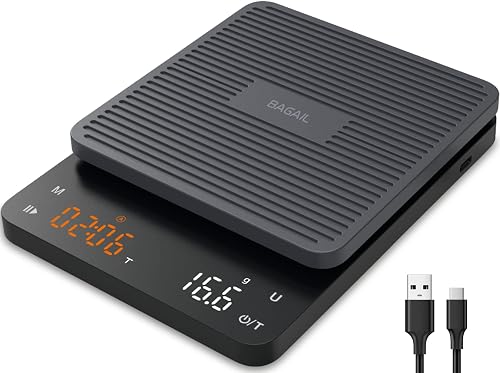
BAGAIL Coffee Scale with Timer, 3 kg
- 3,000 g capacity, 0.1 g readout
- 6.7 × 5.1 in body, roomy enough for a carafe and dripper
- USB-C charging, about 30 days per charge (maker's figure)
- Auto timer and auto tare
If you brew into a large carafe or a batch brewer, the extra kilogram of headroom and the wider top matter more than a slim profile.
Watch out: at 6.7 × 5.1 in, it is too big for many espresso drip trays. The maker's 30 days per charge is a third of what the Maestri House lists.
Check price on Amazon
Greater Goods Coffee Scale with Timer
- 6.6 lb (about 3 kg) capacity, 0.1 g readout
- Count-up and countdown timer, tare button
- Runs on 3 AAA batteries
- 5.25 in platform, 12.3 oz
Batteries mean no cable on a wet counter and no waiting for a charge: you swap them and keep brewing. The countdown timer is handy for French press or bloom timing.
Watch out: the timer is manual, with no auto-start listed, and three AAA batteries are a running cost. Keep spares in the drawer.
Check price on Amazon
Hario V60 Drip Scale (new model)
- 2,000 g capacity, 0.1 g readout
- Built-in timer and auto-off
- Runs on 2 AAA batteries
- 120 × 190 × 29 mm: a long body made for drippers and carafes
It comes from the company behind the V60 dripper, and it is sized for exactly that setup.
Watch out: 190 mm long and 29 mm tall means it won't fit most espresso drip trays. Auto-off is useful for batteries, but check how long it waits before you start long, slow pours.
Check price on AmazonAlso considered
The KitchenTour 3 kg scale is one of the cheapest options with a timer, but the maker doesn't list which batteries it uses, and at 7.2 × 5.2 in it is large for a drip tray. The OXO Brew 6 lb Precision Scale has a well-known name, but its listing doesn't state a power source either.
How to choose
Start with where it will sit
For espresso, size beats every other spec. The scale has to fit on your drip tray and leave room for the cup under the portafilter. Measure both before you compare features. The two espresso picks are about 20 mm tall; the Hario is 29 mm.
For pour-over, the opposite is true: a wider platform is easier to center a carafe on. Add up your dripper, carafe and water. Most single-cup setups stay well under 2 kg, while a 3 kg scale leaves room for big batches.
Decide how much the timer should do
A manual timer works fine for pour-over. For espresso, an auto-start timer saves you from pressing buttons while you lock in the portafilter. Both espresso picks have one, and the TIMEMORE 3.0 adds auto tare.
Pick a power type you'll actually keep up with
USB-C scales are cheaper to run, and the makers here list 30 to 90 days per charge. AAA scales never leave you waiting on a charge, but you will be buying batteries.
Don't count on water resistance
None of the six lists an IP water-resistance rating. A few mention a "waterproof" pad or surface, which protects against drips, not a rinse under the tap. Wipe spills right away.
FAQ
Do I need 0.1 g precision?
For espresso it helps: half a gram is almost 3% of an 18 g dose, enough to change how a shot tastes. For pour-over, whole grams are usually enough, though every scale in this guide reads to 0.1 g anyway.
Can I use my kitchen scale?
For pour-over, yes, if it reads in 1 g steps and updates quickly while you pour. Most kitchen scales have no timer and are too big for a drip tray, so they don't work well for espresso.
What is the difference between an espresso scale and a pour-over scale?
An espresso scale is small enough for a drip tray and usually starts its timer automatically when coffee hits the cup. A pour-over scale has a larger platform and often shows flow rate so you can pace your pour.
Still unsure? Start with your machine: measure the drip tray, then pick the most capable scale that fits.